
Most housing news this fall has been about what is not moving. Contract signings fell again in October, existing-home sales slowed to their weakest pace since 2010, and mortgage rates are still above 7 percent. Against that backdrop, a quieter announcement on November 24 deserves more attention than it got, especially for buyers shopping at the upper end of the Southeast Michigan market. The Federal Housing Finance Agency raised the conforming loan limit for 2027 to $855,400 for a one-unit home in most of the country, up $22,650 from the 2026 limit of $832,750.
That number sounds technical, and for a buyer at the regional median price it changes very little. For a buyer in Ann Arbor, Novi, Plymouth or Birmingham-adjacent neighborhoods, where well-priced homes routinely need loans well above the median, it can change the loan you qualify for, the documentation you face, and sometimes the rate you are offered. Here is what the new limit actually does, and how it fits with this week’s rate move and the local numbers.
What a conforming limit is, in plain terms
A conforming loan is a conventional mortgage that Fannie Mae or Freddie Mac can buy from a lender. Loans at or below the limit follow their standard rules. Loans above it are called jumbo loans. Jumbo loans are not automatically worse, and in some weeks their rates are competitive, but they often come with stricter credit, reserve and documentation expectations, and fewer lenders compete for them.
The 2027 increase is 2.72 percent, the same percentage by which FHFA’s seasonally adjusted House Price Index rose between the third quarter of 2025 and the third quarter of 2026. FHFA said the limit will be higher in all but 24 counties or county equivalents nationwide. The new ceiling for high-cost areas is $1,283,100, which does not apply to Southeast Michigan counties, where the baseline $855,400 figure is the relevant one. The two-unit limit rises to $1,095,250, the three-unit limit to $1,323,900, and the four-unit limit to $1,645,350, which matters for buyers of small multifamily properties. The new limits apply to loans delivered in 2027, and Fannie Mae will apply them to Desktop Underwriter casefiles submitted or resubmitted on or after the weekend of December 5, 2026, so some buyers closing early in the new year can benefit sooner than January 1 suggests.
Put in purchase-price terms, with 20 percent down, an $855,400 loan supports a purchase price of about $1,069,250. Under the 2026 limit, the same math topped out at about $1,040,938. That is roughly $28,300 more home that can now be bought with a conforming loan instead of a jumbo loan, without putting any additional cash down.
Why this matters more in Ann Arbor and Novi than at the regional median
Across the Realcomp region, the median sale price in October was $283,000, up 2.9 percent from a year earlier, with homes selling for 97.8 percent of asking in an average of 40 days. A buyer at that median, with 20 percent down, borrows about $226,400, nowhere near either limit. For that buyer, the limit change is background noise.
The picture is different at the top of our local market. The Ann Arbor metro median listing price is $440,000, down 7.8 percent from a year earlier, with 51 days on market and about a quarter of listings having taken a price cut. In Novi, recent closed sales averaged well into the $600,000s, and in Plymouth Township they have averaged above $650,000. Move into the specific neighborhoods buyers compete hardest for, and $900,000 to $1,050,000 purchases are not rare. Those are exactly the purchases where a loan can land just above the old $832,750 line. A buyer who needed $845,000 last month was in jumbo territory. The same buyer in 2027 is conforming, with a wider choice of lenders and standard underwriting.
There is a seller angle here too. If you are listing a home in that price band this winter, your buyer pool quietly widens in the new year. A home priced just above $1 million no longer forces every financed buyer with 20 percent down into a jumbo loan. That does not create demand by itself, but it removes one friction point at the closing table.
Rates eased this week, but the year-over-year gap is the real story
Freddie Mac released its weekly survey a day early, on November 25, because of the Thanksgiving holiday. The 30-year fixed rate averaged 7.21 percent, down from 7.28 percent the week before. The 15-year fixed averaged 6.54 percent, down from 6.66 percent. Those are welcome moves after last week’s jump, and they return rates part of the way toward the 7.11 percent reading from November 12.
Context matters, though. A year ago, the 30-year average was 6.23 percent. On a $226,400 loan, the loan amount for a median-priced Realcomp home with 20 percent down, principal and interest at 7.21 percent is about $1,538 a month, about $11 a month less than at last week’s 7.28 percent. Small weekly moves help at the margin, but they do not change the basic math buyers have faced all fall. That is also why contract signings keep falling nationally. The National Association of Realtors reported its Pending Home Sales Index fell 4.7 percent in October to 63.0, the lowest reading since the series began in 2001, down 16.7 percent from a year earlier, with the Midwest down 2.7 percent on the month. Existing-home sales ran at a 3.75 million annual pace in October, with a national median price of $416,700 and 5.1 months of supply.
One contrasting data point arrived November 25 as well. The Census Bureau reported new single-family home sales rose to a 701,000 annual rate in October, with a median new-home price of $391,300, down 3.2 percent from a year earlier. Builders are winning some buyers with price adjustments and incentives that resale sellers are only slowly matching. Census cautions that the monthly change carries a wide margin of error, so treat the level as a signal, not a turning point.
What buyers and sellers should do with this
For buyers shopping above $850,000 in loan amount, ask your lender a specific question before you write an offer in December: will my loan be underwritten to the 2027 limit, and does that change my rate, reserves or approval conditions? If you were quoted as a jumbo borrower in October, get a fresh conforming quote for comparison. Keep comparing Loan Estimates from more than one lender, because the spread between lenders can matter more than a 0.07 percent weekly move in the national average.
For buyers at or below the median, the limit change does not help or hurt you. Your levers remain the same ones that have worked this fall: a full pre-approval, flexibility on closing timing, and a serious look at listings that have sat for 40 days or more, where sellers in our region are already accepting about 97.8 percent of asking on average.
For sellers in the $950,000 to $1,100,000 band, talk through timing honestly. Listing in January puts your home in front of buyers who can now use conforming financing at your price point, but it also puts you in front of the new-year supply that arrives with you. Pricing to the recent comparable sales, not to the new loan limit, is still what moves a home.
A higher conforming limit will not fix affordability in Southeast Michigan, and no one should stretch to $855,400 just because the line moved. Used well, though, it removes an artificial barrier for a specific group of local buyers and sellers who were caught just above the old line. If you are weighing a purchase or a listing in that range, or anywhere in the Ann Arbor area, IKL Real Estate in Ann Arbor can walk through the numbers for your price point, call or text 734-926-9444.
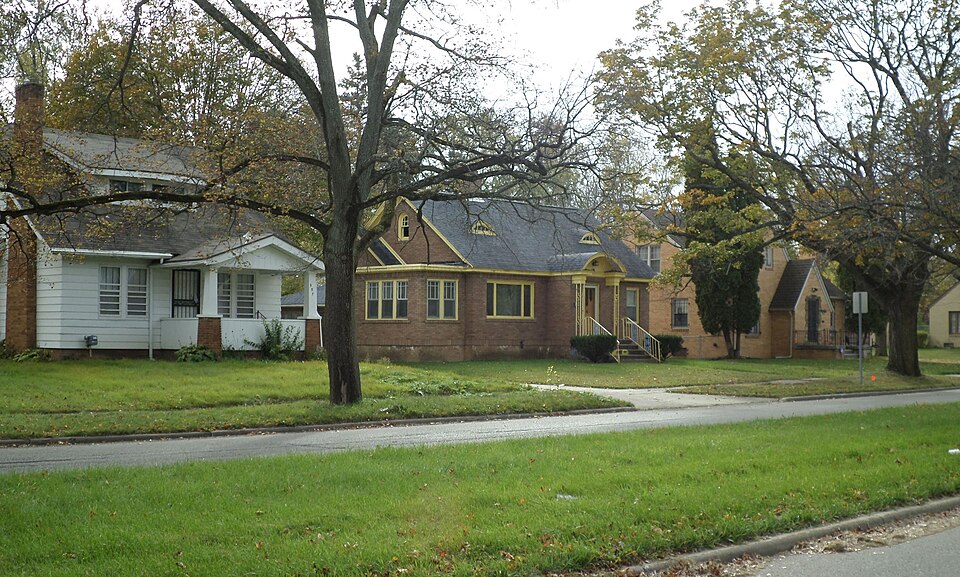
Featured photo: Houses along West Hamilton Avenue in Flint, Michigan, by kennethaw88 via Wikimedia Commons, licensed under CC BY.
Sources: FHFA, “FHFA Announces Conforming Loan Limit for 2027,” November 24, 2026, https://www.fhfa.gov/news/news-release/fhfa-announces-conforming-loan-limit-for-2027 ; Freddie Mac, Primary Mortgage Market Survey and PMMS Archives, week ending November 25, 2026, https://www.freddiemac.com/pmms/pmms_archives ; Freddie Mac Single-Family, “2027 Loan Limits Increase by 2.72%,” https://sf.freddiemac.com/articles/news/loan-limit-values-for-2027 ; Fannie Mae, Loan Limits and Lender Letter LL-2026-10, https://singlefamily.fanniemae.com/originating-underwriting/loan-limits ; National Association of Realtors, Pending Home Sales, October 2026, and Existing-Home Sales, October 2026, https://www.nar.realtor/research-and-statistics/housing-statistics ; Realcomp, October 2026 Market Snapshot (median sale price $283,000, 97.8 percent of asking, 40 days on market); Realtor.com, Michigan and Ann Arbor metro market data, November 2026, https://www.realtor.com/local/market/michigan ; U.S. Census Bureau and HUD, New Residential Sales, October 2026, released November 25, 2026, https://www.census.gov/econwidget?noheader
0 Comments