
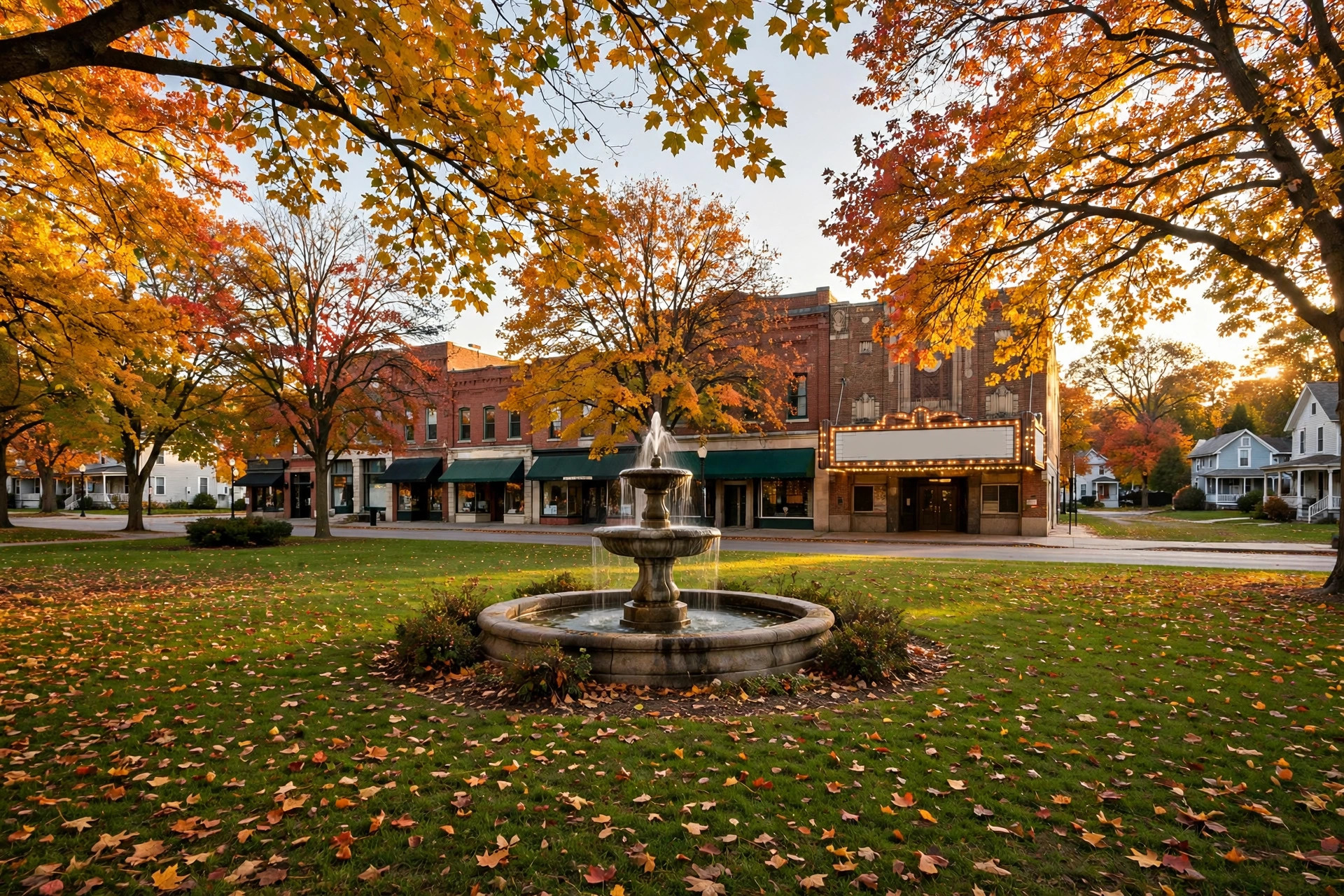
Plymouth is only about 2.2 square miles, but it punches well above its size in Southeast Michigan real estate. Centered on Kellogg Park, with a walkable downtown, the historic Penn Theatre, and tree-lined streets of older homes, the city draws buyers who want small-town life without giving up access to Ann Arbor, Canton, and Livonia. That appeal shows in the fall 2026 numbers: while much of the region slows into the season, homes in Plymouth Township still sell in about three weeks and close essentially at asking price.
Plymouth is really two markets in one. The city itself is compact, with a 2020 Census population of 9,370 and an estimated 9,164 residents on July 1, 2025, according to the U.S. Census Bureau. Surrounding it, Plymouth Charter Township offers larger, more suburban neighborhoods. Buyers often shop both at once, so the clearest picture comes from township sales data alongside county and regional trends.
What Makes Plymouth Different From Its Neighbors
Most Southeast Michigan suburbs are built around driving. Plymouth is built around walking. Downtown serves as the commercial heart for the city, the township, and parts of Canton, with shops, restaurants, and events steps from front doors near the park. That walkability, plus a historic district around Kellogg Park and a steady calendar of festivals and concerts, creates demand that does not depend only on price per square foot.
The housing stock reinforces that premium. Near downtown are Victorian and Craftsman homes and cottages in Old Village, Plymouth’s original working district. Farther out in the township are mid-century homes, larger colonials, and newer construction on bigger lots. A small historic home near the park and a newer township colonial can differ by hundreds of thousands of dollars, and both can sell quickly when priced to recent comparable sales.
What the September 2026 Numbers Show
In Plymouth Charter Township, 17 homes sold in September 2026 at an average sales price of $651,589, according to local MLS market data published in mid-October. Those homes averaged just 21 days on market and closed at 99.97 percent of asking price, on an average listed price of $586,795. In plain terms, township sellers who priced realistically got essentially their asking price, and they got it fast.
That pace stands out against the wider region. Across Realcomp’s entire Southeast Michigan MLS footprint in September, the median price was $295,000, up 4.3 percent from September 2025, with homes averaging 37 days on market, 3.5 months of supply, and a sale-to-list ratio of 99.5 percent. Wayne County, which includes Plymouth, posted a median price of $218,000, up 3.8 percent year over year, with homes averaging 33 days on market and 4.0 months of supply. Plymouth Township, at 21 days and 99.97 percent of asking, ran notably hotter than both the county and the region.
Nationally, the picture was slower. The National Association of Realtors reported existing-home sales at a seasonally adjusted annual rate of 3.99 million in September, up 1.5 percent from August but down 2.2 percent from a year earlier. The national median price was $417,500, up 1.3 percent, and the Midwest median was $329,600, up 3.1 percent, with a median time on market of 33 days. Plymouth’s combination of higher prices and faster sales than those benchmarks reflects a simple reality: inventory near a truly walkable downtown stays scarce, even in a slower national year.
What Buyers Should Do in Plymouth This Fall
First, get fully pre-approved before you tour. A home that sells in 21 days at full asking does not wait for a buyer who still needs to sort out financing. Second, separate the city from the township in your search. City homes trade on walkability and historic character; township homes trade on space, lot size, and newer systems. They also sit in different municipalities, so taxes and services differ. Compare each home against recent sales in its own side of Plymouth, not against Plymouth as a whole.
Third, use the fall season without assuming it means a discount. Region-wide, supply reached 3.5 months in September, the highest September level in three years, and sellers closed at 99.5 percent of asking rather than 100 percent in August. That gives buyers a little more room on homes that have sat, on inspection items, and on timelines. It does not mean a well-priced home near Kellogg Park will wait for a low offer. In the city core, be prepared to act at or near asking.
What Sellers Should Do in Plymouth This Fall
Plymouth sellers start with an advantage, but September’s regional data carries a warning: buyers now have more homes to compare than at any point in the last three autumns, and they are using that choice. Price to the last ninety days of closed sales in your specific part of Plymouth, not to spring prices and not to a neighbor’s asking price. In the township, the homes that moved in 21 days at 99.97 percent of asking were the ones priced to the market from day one.
Presentation matters more here than in many suburbs, because much of Plymouth’s value is how a home feels. Clear fall maintenance, leaf cleanup, warm lighting for shorter days, and honest attention to the systems buyers worry about in older homes, such as roofs, furnaces, and windows, all help a listing stand out. If your home needs work, price that work in openly rather than hoping buyers will overlook it at a premium price.
The Rate Backdrop Heading Into November
Financing eased slightly at the end of October. Freddie Mac reported the average 30-year fixed-rate mortgage at 7.24 percent as of October 29, 2026, down from 7.32 percent the week before and the lowest level that month, while the 15-year fixed averaged 6.60 percent, down from 6.68 percent. Both remain well above a year ago, when the 30-year averaged 6.17 percent and the 15-year averaged 5.41 percent, so the improvement is modest rather than dramatic. For Plymouth buyers, that small dip modestly improves purchasing power, and for sellers, it may bring a few more qualified buyers to late-fall showings.
Plymouth will likely remain one of Southeast Michigan’s steadier markets through the winter: small, supply-constrained, and supported by a downtown people genuinely want to live near. Whether you are buying your first Plymouth home, moving up within the township, or preparing to sell a house near the park, the right strategy starts with the numbers for your street, not just your city. If you would like help reading those numbers or planning your next move, contact IKL Real Estate in Ann Arbor at 734-926-9444 by call or text.
Sources: Freddie Mac Primary Mortgage Market Survey, week ending October 29, 2026, via GlobeNewswire (https://in.tradingview.com/news/globenewswire:36fe9b240094b:0-mortgage-rates-decline-further-to-7-24/); National Association of Realtors, Existing-Home Sales, September 2026 (https://www.nar.realtor/newsroom/existing-home-sales-increased-1-5-in-september-according-to-nar-report); Realcomp/InfoSparks Southeast Michigan Market Report, September 2026, via The Patrick Group (https://www.thepatrickgrp.com/market-updates/september-2026); Plymouth Charter Township residential market trends, September 2026, Jag Gill Realty (https://www.jaggillrealty.com/2026/10/15/september-2026-plymouth-charter-township-mi-residential/); U.S. Census Bureau QuickFacts, Plymouth city, Michigan (https://www.census.gov/quickfacts/fact/table/plymouthcitymichigan/HCN010222)
0 Comments